Monday, December 5, 2011

Quito - Galapagos Islands

26 Nov 2011

Quito - Galapagos

5.30 is a great time of the morning - oh yes it is!  Another trip back to the airport awaited us after breakfast, but at least as it was weekend, the traffic was a little less mad.

Quito airport made up for it in spades though!  Check in reminded me of a rock concert just after they open the doors and everyone is trying to get to the front by the stage.  After some searching, we did find there were a number of what might have been queues, but no visual sign about which desk was handling which flight. There were flights to Cuenca, Coca, Guayaquil and Baltra all leaving at roughly the same time.  People for the earliest flight to Cuenca were behind us and they were sometimes helped by officials to get to the front of the scrum.  Suddenly, our 'queue' started moving and we managed to pick up boarding passes and check in our luggage.  By this time it was less than 30 minutes before our flight was due to leave and we still had security to deal with.

Once in the departure lounge, we heard that final boarding for our flight was taking place, so we rushed straight through and out onto the tarmac where there were 2 aircraft.  Luckily, we got the right one, because there was no obvious signs as to which was going where.

Amazingly, the flight almost left on time and we headed to Guayaquil some 30 minutes flying time away.  Guayaquil lies on the Pacific coast and is Ecuadors biggest city.  Once there, we stayed on the aircraft whilst many others left the flight.  The cleaners came on and cleaned around us and then quickly they started boarding more passengers.

New arrivals include a noisy party of South Koreans, but soon after we were airborne for the 2 hour flight out into the Pacific to the Galapagos Islands.  Also on our flight was a huge party from Tupperware who were on a day trip to the Galapagos! I wonder how much they had to sell to get a 'jolly' like that?

We had excellent views of some of the islands as we came in to land, the sea was an electric blue colour.  Once off the aircraft, we were carefully checked in to make sure that we'd payed our National Park Entrance Fee of $100. 

The main airport in the Galapagos is at Baltra, an airfield built by the Americans during the 2nd World War mainly to be able to defend the Panaman Canal not too far to the north.  The island is very flat and the foundations and ruins of the enormous airbase are still easily visible.

Arrivals was just a largish shed (perhaps I'm doing it a disfavour here) and luggage was moved into the shed on tractors and trailers. It was then uncermoniously dumped on the floor and a 'sniffer dog' let loose in amongst the bags.  Food and seeds are forbidden to be imported to the islands, in case it contaminates the ecostructure of the islands.

We boarded a small coach that took us to the channel between Baltra and Santa Cruz Islands.  Here we got off the coach and saw our luggage off a small lorry.  The bags were put on top of the ferry and we all climbed inside.  Once on the island of Santa Cruz, a bus was waiting for us and after loading our luggage, we headed south across the island, climbing all the time.

332
Giant Land Tortoise


High up on the mountain, we took a short diversion to a farm where we saw in excess of 80 giant land tortoises, we decided that we'd seem larger in the Seychelles,  but it was interesting to see so many.

333
Hot Giant Land Tortoises - trying to cool down


After an ice-cream, we continued on south, and back downhill, to Puerto Ayora.  This small town is the biggest on the island and has many shops, a few hotels and is where many people, including ourselves, join their small cruise boats.  We jumped into a inflatable dinghy and motored across to the Galapagos Voyager, our home for the next week.  The boat only has eight cabins so there are only ever 16 guests on board.

After a quick look at our cabin, we headed back to shore and went to visit the Charles Darwin Research Centre, whose main purpose is to preserve some of the rarer island tortoises.  Amongst the inmates of the Centre is 'Lonesome George' the only Giant Tortoise from the island of Pinto left on the planet

Back on board, we had a briefing about our programme for the next week and the ships routine was explained.  We were told that we would be sailing overnight between midnight and 3.00 in the morning and would be heading to South Plaza Island.

After an excellent dinner on board, we settled down in our small cabin for our first night aboard.

Cuenca - Quito

25 Nov 2011


Today we had a real treat, a lie-in!

Convent in Cuenca


After a late breakfast, we headed down to the Rio Tomebamba behind the hotel and saw hummingbirds, wagtails and Ruffous-collared Sparrows.  Following this, we packed our baga again and then crossed the road for a cup of coffee whilst we waited for our airport transport.

Spanish Colonial Houses - Cuenca


Much to our amazement, Cuenca airport is very modern and air-conditioned, so waiting for our flight was painless.  The flight was on time and we headed back north to Quito passing through a storm cloud shortly before landing.  I've rarely heard rain so hard on a aircraft fuselage whilst still airborne.

Quito airport was its usual chaotic self, but we found our tour rep who scooped us up and got us to our bus.  We were pleasantly suprised to find Lois 2 driving the bus!

Back at the Dann Carlton we collected our left luggage and headed back upstairs to unpack and repack in anticipation of our Galapagos trip tomorrow.

As it was still raining, we snuck through the hotel casino into a back street where we knew there was a restaurant next door to the hotel.  The decor in the restaurant was in the 'minimalist' style and had some odd features, not least a couple of tables surround by pink mosquito nets hung from the ceiling.  The food was, sort of, nouvelle fusion cuisine and very tasty, but the service was rather variable.  This might have been because it was the begining of a fiesta weekend and the restaurant was very busy.  Most of the women were given a rose on arrival, but we decided this was for those who had pre-booked.

Back at the hotel, we logged onto the internet, and shortly after that the room started swaying gently!  (I don't think the twos events were associated!)  It lasted about 30 seconds and we realised we'd experienced an earth tremor on the fifth floor of a building, an interesting experience!  (It seems that earth tremors are so normal, it didn't even make the local press.)  We did the last bits of packing and went to bed early as, guess what, we have another early start tomorrow!

Saturday, December 3, 2011

Cuenca

24 Nov 2011


We were up fairly early again and headed to the dining room to try out breakfast.  It was a rather stilted affair as there was no buffet, everything was served at our table.  The food was fine and we were entertained by Thrushes and a couple of Hummingbirds in the tree right outside the window.

Spanish Colonial House - Cuenca


Lois 1 came to pick us up and we went on a walking tour of the old part of the city.  We saw both the old and new Cathedral in the central square and continued to a convent close by where a thriving flower market was ongoing.  The walk took us on a circular route that eventually returned us to the hotel.  The old city mainly consists of old colonial Spanish buildings and is very attractive.

Catedral Vieja - Cuenca


We almost saw an interesting bird in town, we noticed it tweeting above us as we crossed the street at some traffic lights.  Some of us realised more quickly than others that it was an audible sign from the traffic lights indicating that it was safe to cross the road!


Catedral Nueva - Cuenca


We also visited a small market in the middle of town, three floors of fruit, vegetable, fish and meat.  For those of a squeamish nature, avoid the rest of this paragraph and the next picture.  We had previous seen the meat market at Latachunga with it's on-site butchery along with every part of each beast on sale.  In Cuenca, they were also selling skinned guinea-pig, I guess it is no different than selling skinned rabbits...

Guinea-pig to go!


Back at the hotel, Lois 2 was waiting with the bus and we drove to the Mirador de Turi overlooking the city where the views were very expansive. We also had a chance to visit the ceramics workshop of Eduardo Vega where there were the most beautiful pieces of ceramics for sale, none tremendously expensive.  We almost spent some money, but the worry about getting breakables back to UK in one piece stopped us!

Onward again by bus to a Panama Hat factory near the airport.  Oddly, Panama hats are not made in Panama, but mainly in Ecuador, the best made in Cuenca.  The process of fashioning the hats, starts as home industry with women weaving the basic shape from palm leaves in their own homes.  Following this, the hats are washed, dried and shaped in the factory and finally have their traditional black band sewn on by hand.  The hats range in price from about $20 right up to $2000!  The price is dependant on the quality.  We handled hats priced at several hundred dollars and those at $20 dollars, the difference is appreciable, the more expensive ones can withstand being screwed up and soaked and still come back to their proper shape, they also feel a lot softer.  After the tour we left hatless!

Indingenous daily wear


Back at the hotel, we said farewell to Lois 1 and 2 and they set off for Quito in the bus which would take them roughly 9 hours north up the Pan-American Highway.

We had a lazy afternoon whilst it thundered and rained, but ventured out to a textile market eventually, thinking that the rain had stopped. Wrong!  We dodged around trying to avoid getting soaked and looking at the shops.

In the evening, we returned to Raymipampa restaurant as we had been so impressed by the food.  Several of the group tried the Churaszo whilst I tried Camarones - Ecuador Prawns.  (I think someone told me that Ecuador is the 2nd or 3rd largest exporter of frozen prawns in the world).

Riobamba - Cuenca

23 Nov 2011


We are getting used to early starts - really!  We left the hotel at 6.00 after we had breakfast and headed through the western flanks of the Andes to Alausi a small town about 1 hour from Riobamba.

Here we left the bus and climbed aboard a train which promptly left the station bound for Sibambe a the foot of the 'El Nariz del Diablo' or Devils Nose Railway.  This remarkable feat of engineering sees the railway line descend from Alausi to Sibambe, dropping from 2607 metres above sea level to 1806 metres en route at a gradient of 1-in-18.  There is no 'rack and pinion' for extra traction and the diesel engine manages to tow trains up and down, albeit rather slowly.

El Nariz del Diablo Railway


The line is single track and the ledge was blasted out of the cliff by Jamaican 'slave' labour with huge loss of life in the early 1900s.  The route includes a 'zig-zag' during which the train pulls up to buffers whilst the points behind it are changed, then reverses down the next section of track, before repeating the manoeuvre again to start going forward.

Lynn and the train at Sibambe station


At the bottom, we were treated to a display of Ecuadorian dancing and were given a snack of sandwiches and coffee.

Train Bus at Sibambe


After about an hour, after another single carriage train looking like a bus on railway wheels came down, we started back up the 'Devils Nose' arriving back in Alausi about 30 minutes later.  We were involve in a minor tourist incident on the journey back when a petulant German tourist became most abusive because he could sit where he wanted to sit.  We eventually defused the situation by moving, for which we were rewarded by the train guard with souvenirs of the railway!  Still at least we didn't steal German sun-loungers this time!

Once back in Alausi, we got back on the bus and headed out of town to continue our southerly journey.  After about an hour, we stopped at a petrol station and ate a packed lunch supplied by the hotel in Riobamba.

From hear, we continued south through spectacular mountain scenery to the town of Incapirca, high in the mountains. Here we visited ruins of the Inca town built here.  The Inca town was built next to an older native village and included the remains of a spectacular sun temple.  It is still a mystery as to how they managed to cut blocks of stone so precisely, as they never discovered steel and only had soft metal tools.  Incas also never discovered the wheel either.  Whilst we were there, a huge local funeral processed down the hill to the church and cemetary, hundreds of people following the hearse, a barely modified estate car.

300
Ingapirca ruins


During the journey south from here, we encountered a thunder storm and torrential rain.

Finally, we started heading downhill to Cuenca situated where 4 rivers join in a mountain valley at 2500 metres.  The old part of the city today still mainly consists of Spanish Colonial buildings erected on top of the Inca city after the Spanish had conquered them.  It is a delightful city.  Our hotel, the Victoria, was built on the edge of the old town and was a converted Colonial mansion.  All the rooms overlooked the Rio Tomebamba.

After we had checked in, we managed to make a reservation for dinner at Raymipampa cafe/restaurant next to the 'New' Cathedral where we ate fantastic local food, mainly beef and chicken and at very reasonable prices.

Quito - Riobamba

22 Nov 2011

Guess what?  Yep, another early start as we were due for a pick-up at 8.00 at the hotel.  Once again, we stored a couple of bags, just taking one small suitcase with us for the next few days.  We'd been told that it might be quite cold up in the mountains and we might get rain too, so we took fleeces and anoraks with us too.

Shortly after 8.00 a Mercedes 9-seater mini-bus turned up with Lois the tour guide and Lois the driver.  Lois 1 and Lois 2!  After loading our luggage and equipped with camera, video and binoculars we bagged the first row of seats.  We then continued to another hotel and picked up four more Brits, Ian and Carol and Brenda and Geoff, all from Yorkshire.

Getting out of Quito was fairly mad as it was rush-hour, but eventually, we started climbing a hill to the south of the city and stopped briefly for a photo-stop to look down on the capital.  The road we were to follow mainly for the next two days was the Pan-American Highway.  Clearly the Ecuadorian government is spending a lot of money trying to upgrade the road to dual carriageway for at least 100 miles from Quito.  It is clearly a challenge to local drivers to see just how quickly they can progress through the ongoing road-works, including driving on coned-off and indeed un-surfaced sections of the road.  It is also essential to overtake on blind bends and double white lines clearly mean you are invited to overtake at any time you like!

Nonetheless, the journey was fascinating and gave us an insight into Ecuadorian life not visible from an aeroplane.  After a couple of hours, we arrived at Latachunga, a large provincial capital and we stopped at the local market.  We were slightly concerned about this visit as often on holiday itineraries, 'local market' usually translates as 'Tourist' market where you are hassled to buy cheap souvenirs.  This, however, was very different and was a market for the local people and was selling fruit, vegetables, meat, baskets and other items for daily use.  There were also lots of food stalls.

We had been told that Ecuador is 'self-sufficient' and doesn't import any food and we could see fabulous fruit and vegetables for sale.  The food snack stalls, on the other hand, were selling food deep-fried in batter.  It seems that the local diet does not include all the amazing fruit and vegetables, but does include lots of high-fat meals.  Much of the fruit and vegetables are apparently rejects for the highly lucrative food export business.  Ecuador is a huge exporter of bananas, but only the highest quality and perfect-looking gets sent to places like UK. How sad, especially as prices are very low.

Latachunga Market


We discovered that you can't buy bananas, for instance by picking 2 or 3, but have to tell the stall-holder hour much you are prepared to pay.  We asked for 50 cents (35 pence) worth of fresh bananas and ended up with a couple of kilos!  We also bought 4 grenadines for 1 dollar.  None were wasted as we ate them over the next couple of days, they were delicious.

As we drove south we were following the Avenue of Volcanos, named by Alexander Humbolt.  Although it was cloudy, we did see Mt Cotopaxi and several other of the high peaks.  the snow-line in Ecuador is at 5000 metres all year round, so it is easy to gauge the height of the mountains.

Mount Cotopaxi


We continued on to Ambata a large city an hour further south and turned off to circumnavigate Mount Chimborazo, another snow-covered volcano about 6200 metres tall.  As we started to climb out of the fertile valley, already at 2800 metres above sea-level, the scenery started to change.  We slowly lost the trees and moved into the high altiplano or paraimo of scrub and near-desert conditions.  These are the conditions that LLama and Alpacas love and we started to see them roaming wild. 

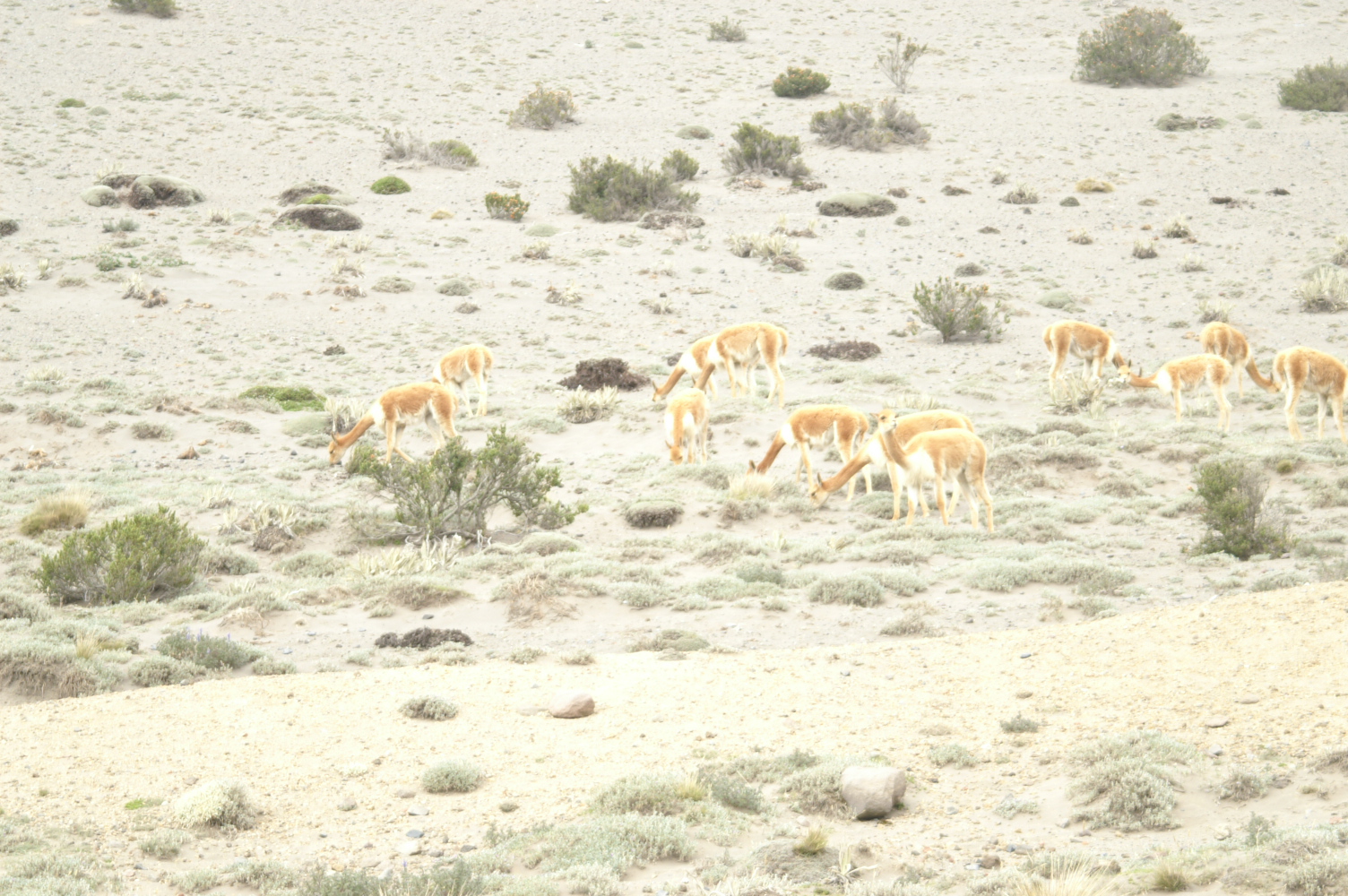
As we climbed further we and vegetation started to get really sparce, we found wild Vicunyas, another sort of Llama.  These high-altitude animals had been hunted to extinction, but the government was now reintroducing them with animals bought from Argentina.

253
Vicunya - high on Chimborazo


Finally, high on the slopes of Mt Chimborazo, we turned off up a dirt track toward the Whymper Refuge.  This refuge, now mainly abandoned used to be the start point for mountaineers climbing Chimborazo and is named after Edward Whymper, a Brit, who was the first recored climber of the mountain.  We briefly parked at the refuge 4700 metres above sea-level and puffed our way up to monument.  One or two of our party were begining to feel the effects of altitude sickness, so we quickly got back in the bus and descended to the new Chimborazo Mountain Base-camp and a very late lunch.

259
Chimborazo - 4700metres above sea level - Whymper Refuge


Following lunch we carried on down the mountain to Riobamba where we were due to stay.  The hotel, a lodge called Abrospungo, was on the outskirts of town and was very peaceful.  Due to our late lunch, none us felt hungry, so didn't join the huge party of Germans who were also staying there.  Instead we had a beer and a sandwich before heading for bed.

Sacha Lodge - Quito

21 Nov 2011

Today is our 13th Wedding Anniversary, what a way to celebrate!

Evening View of Lake Pilchicocha


This morning, we had another early start so we could do our packing.  Leaving the bags outside the room we ventured down to breakfast, I think we both need to diet after the food we have had for the past few days!  Just outside the dining room, about a dozen Black Vultures were roosting in the trees.

After breakfast, it was into the canoe for the last journey across Lake Pilchicocha, then the 20 minute walk back to the Rio Napa.  During the canoe ride, we saw more Woodpeckers and heard the Red Howler Monkeys again.

95
Baggage canoe on Lake Pilchicocha


Back at the river, it was into the big canoe with enormous outboard engines for the 2 hour, 50 mile journey back up the Rio Napa to Coca.  During the journey, we saw quite a bit of bird kife, notably Egrets, White Hawks and Cocoi Herons.  A real luxury today was the snack bag we were give to eat en route up the river. 

Again, it was obvious just how shallow the river is as we slid over several sandbars, one almost caught us, but a huge burst of power from the engines forced us over it.

Back at Coca, we again ventured into Sacha House where abandoned our life jackets and picked up some more cold water before the drive to the airport.  At the airport it was fairly chaotic and we were informed that our flight had been delayed due to clould at Quito.  The wait at the airport was somewhat uncomfortable, especially as the huge air-conditioning units were firmly switched off, despite the temperature being in the mid 80s and humidity at about 90%.

Eventually, the aircraft arrived and we departed shortly afterwards on the 30 minute flight back through the Andean Mountains.   Snow-covered Cotopaxi could easily be seen from the aircraft.

In Quito, there was no sign of our tour rep, so we waited outside fending off various hawkers and taxi-drivers.  After a short wait, our rep arrived and we had to hike to the car park to find our car.  Luckily traffic wasn't too busy and we got back the Dann Carlton quite quickly.

Next, we retrieved our stored luggage and unpacked everything and then repacked in anticipation for our journey down to Cuenca tomorrow.  We are starting get the hang of this, which is as well and will be doing it again several times before we leave Ecuador.

For our evening meal, we pushed out the boat a bit and found an Argentian Parillia (I think that is the right word) round the corner from the hotel.  BBQ meat is the main meal at these places and we both ordered pork ribs, something we both love.  I've never seen ribs so large and with so much meat on - one order between two would have been better.  As for the taste and quality of the food - it was simply delicious, especially washed down with a bottle of Argentian Wine.

All in all, a great and memorable anniversary!

Sacha Lodge

20 Nov 2011


After a lie-in (to 6.00) we quickly ate breakfast and headed out from the lodge in another small canoe, our destination was Anaconda Creek.

This creek was the same one that had a Caiman nest in it so we had to take a slight detour to avoid it again.  We intended to look for Anacondas and other wild mammals.  Before we got into the creek though, we saw and heard several woodpeckers in the trees surrounding Lake Pilchicocha.

As we entered the creek, we saw several very large Hoatzins crashing around in the trees.  These large turkey sized birds are fairly common and seem to be very clumsy as they try to find perches in the trees.  Further down the creek we could hear, but not see, Red Howler Monkeys.  The noise they make sounds like a strong wind blowing through trees.  We got fairly close to them, but never saw them.

Hoatzin


Deep in the jungle we got out of the canoe and went for a walk through.  Once again were looking at the trees and plants.  Jaime, our indiginous guide, explained about the medicinal properties of several plants. After about an hour, we found our way back to the canoe and headed back to the lodge.  No Anacondas seen!

Back at the lodge, mid-morning, we were told that monkeys had been seen just behind the dining room.  Sure enough we found several Pygmy Monkeys in the low branches of a tree only a few feet from the boardwalk.  They are the smallest monkeys found in South America.  They were very diffult to photograph as the light was low and the monkeys were scuttling around quite fast.

Enormous Blue Moth!


Before lunch we visited the butterfly house, some of the larger moths were huge. Not being very skilled at identifying butterflies and moths I couldn't begin to say what we saw.  Some moths had huge owl-eyes on the wings and some blue butterflies were enormous.  Oddly in the enclosure, there were no Morph butterflies, but we saw these enormous butterflies in the forest around the lodge every day.

137
Owl-eyed Moth


After lunch, we found one of the chefs dropping food scraps to a Caiman right underneath the dining room, it was a shame we couldn't photograph it.

Later in the afternoon as we were heading back to go out on another 'expedition'when Lynn found several Black-Mantled Marmosets, another species of monkey-like mammals.  Once again they were very close to the lodge and didn't seem very worried by us watching them.

A brief note about canoes.  We used three different types, the first on the long river journey took about 20 passengers and had huge outboard engines on the back.  The second was a fibre-glass hulled, hand-paddled, canoe where passengers sat in rows of two and took 6 to 8 passengers.  The third was a small narrow, wooden, hand-paddled boat which only took 4 passengers, one row of two and 2 rows of single seats.  In all of them, you are very close to water.  Seats are very low and getting in and out is only really possible with some help!

We set out in the afternoon on the smallest canoe through one of the creeks.  The Night Heron was still hiding in the tree at the entrance and soon afterwards we found a large Lizard on a branch over our heads.  We slowly paddled along the creek and eventually arrived at a landing stage deep in the jungle.  We scrambled up some rough steps on a muddy bank and shortly afterwards came to a huge wooden tower built around a massive Kapok tree.

Although not quite a tall as the aerial walkway we had previously visited, the tower took us up into the canopy of the forest.  From here, we could see for miles, in fact we could just make our the Rio Napo in the far distance.

Bird life was prolific in the canopy and at various times we saw, Purple-Throated Fruit Crow, Russet-Backed Oropendolas, Spangled Cotingas, Black-Capped Eronymus, Ruffous-Bellied Euphonia, Cobalt-Winged Parakeets, and both types of Toucans.  In the distance we could also see a Red Howler Monkey sleeping in the top of a tree.  I'm sure that I've missed several birds that we saw.  The Fruit Crows and Oropendolas were very obliging and posed for photographs!

173
Russett-backed Oropendola


As we were about to leave, we realised that in the tree we were perched in was another Three-Toed Sloth - what a great end to our visit.

By now, the light was begining to fade, we set off down the tower and back to the canoe for an evening paddle through the jungle and back to the lodge.

Sacha Lodge is a very special place and it would be easy to spend longer here, both of us could have spent hours on the tops of the towers watching the wildlife!