Tuesday, December 6, 2011

Quito - Bellavista Cloud Forest

04 Dec 2011


We were up well before 6.00 and were at breakfast shortly afterwards.  We abandoned two of our bags at the hotel and slightly early, our transport arrived to take us to Bellavista Cloud Forest Lodge.

There were already two German ladies on the minibus and the driver said we had to pick up four more passengers.   We drove out of the city centre into a residential area where the driver had great difficulty finding the correct address for the pick-up.  Eventually, we found it and two Americans climbed into the minibus, one of whom then directed the driver to another address, where we waited for another American women to get in.  From here, were went to yet another address for a fourth American.  By now we had been in the bus for close to an hour and were running late.

As we headed north out of Quito one of the American women starting talking, loudly - she never stopped!  We discovered in the space of the next 2 hours her entire life story, her family relations, every job she had ever done, boyfriends she'd had.  She didn't like Quito, where she was teaching English and the air was too thin for her.  She was so pleased we were descending so she could get more oxygen!  I wanted to suggest that if she shut her mouth and stopped talking she might get more oxygen (and give us some peace).

North of the City, we crossed the Equator yet again, this time into the Northern Hemisphere. The Ecuadorians have built a sort of theme park on the Equator called 'La Mitad del Mundo' or 'The Middle of the World'.  There is a large monument here to celebrate lattitude 00 degrees.  I  believe that in fact it has been found to be 7 seconds of a degree to the south of the line, about 240 metres away, but who cares!

From here our route took us over a low pass and then followed a very deep valley down through the foothills of the Andes.  Eventually, after about 90 kilometres, we reached a dirt road turn off and started heading back up hill to the lodge.  The road climbed for 14 kilometres on an unsurfaced road high up into the hills.  About 30 minutes later we reached the lodge.

The lodge was built by an Englishman and his partner about 20 years ago on the site of an old cattle and horse farm.  The vegetation is starting take over again which surrounds the hotch-potch of buildings all built from local woods.  We were accommodated up a very narrow circular staircase in the Mirador Suite.  The room had a lounge with a couple of sofas and large sliding windows, a small kitchenette, and bedroom with large sliding windows and a shower room.  There were no curtains and there was nobody to overlook us!

All the rooms are different at the lodge, some in the main building, some in two houses a 100 metres away and some about the restaurant.

We had a second breakfast, and decided that whatever the Americans were doing, we would go in opposite directions as we were so fed up their constant gabbling - we'd never see any birds with them around.

Two guides offered to different walks in the cloud forest, the Americans elected to go to their rooms and the rest of us, some we had been on the Galapagos Voyager with, split into two small groups and set off into the forest.  Lynn stayed at the lodge to do some static bird-watching and photography.

Tutu flower - much loved by hummingbirds


All the trails were very narrow, some quite steep and many very slippery.  The cloud forest is very different to the Amazon basin forest as the trees are lower and more light reaches the forest floor, thus there is more vegetation.  It felt very 'jungly'.

We were lucky and saw Toucans, fly-catchers, warblers and best of all Masked Trogon, a very bright red bird.  After a couple of hours we returned to the lodge for break and lunch.

A rather distant view of a Plate-billed Mountain Toucan


The restaurant was built as a geodesic dome with the dining room and bar on the ground floor, 3 guest rooms up a spiral bamboo staircase on the first floor, a further 6 beds on the second floor reached by a ladder and three further beds even further up the ladder at the top of the building!

A Hummingbird


After lunch, some of our group from the Galapagos, were returning to Quito after their brief day visit to the lodge so we said goodbye to them before our small group headed down the road for another walk.  we walked about a kilometre down the dirt road and then climbed back up 500 metres on a very steep, narrow track to the lodge.  At first, the bird life was almost non-existant, but towards the end of the walk we saw lots, including Woodcreepers and Woodpeckers.

Booted Racket-tail - a very small hummingbird


Back at the lodge, we sat outside and watched the Hummingbirds on the feeders.  There were at least 14 different species, some so small they were barely bigger than a bee.  They are quite unworried about their audience and everyone was trying to get good photos of them.  They are a difficult subject as their wings are beating so fast and they dart around so much.

Violet-tailed Sylph - a spectacular hummingbird


At dinner, the Americans seemed determined to drown out any conversation, the only people to attempt to compete with them were four German ladies!  We headed back to our room to read, catch up with blogging and then went to bed.

Galapagos Islands - Quito

03 December 2011


My 60th birthday!  After a very peaceful night at anchor in Puerto Ayora, Santa Cruz, we all woke up refreshed, but sorry that we were going to have to leave the boat.  We did our final packing and went to breakfast, where Lynn organised all the passengers into singing 'Happy Birthday' to me - very touching!  The Captain even came to congratulate me!

Male Frigate bird over the Galapagos Voyager


Not long after breakfast, our bags were loaded on a dinghy and taken ashore.  After saying a final goodbye to the crew, we too were loaded into the dinghys one last time to go ashore.

Female Frigate bird over Galapagos Voyager


On the shore, we were reunited with our bags and loaded onto a bus for our journey back to the airport at Baltra.  On the way, we stopped a twin collapsed volcanic craters for a look.  They were quite an impressive sight.  Then it was back on the bus and onward toward the airport.

The road from the summit of Santa Cruz, Baltra Island in distance


As before, we had to get off the bus with our luggage and load ourselves, and baggage, onto the small ferry that sails between Santa Cruz and Baltra islands.  At the far side, it was off the ferry, make sure our bags were loaded onto a lorry then jump on a small bus up to the airport.

At the airport, we again collected our bags and headed for the chaos of check-in.  To be fair, it could have been a lot worse and after about 30 minutes we were safely ensconced in the departure lounge waiting for our flight to arrive.

The flight was on time, and this time we didn't go via Guayaquil so it was a much quicker journey back to Quito where we were met by someone from the Andean Travel Company.

Our trip back to the hotel was somewhat difficult as there were parades going on to mark the foundation of Quito.  This festival goes on for a couple of weeks reaching its peak on 06 December.

We went out to dinner to Tony Romas for ribs and shrimps, the restaurant was quiet but the food very good.  On the way back in the taxi, we drove past Carolina Park where dozens of giant statues of Hummingbirds had been erected.  All were decorated in different colours and hoards of people were wandering around looking at them. On the roads, in addition to the usual traffic, there were loads of 'party buses' cruising around.  These buses often had a band on the roof, passengers in the trucks and more on platforms suspended from the back of each lorry.  There was very loud music from a concert in Carolina Park too.

Once back at the hotel, we could still hear the concert so we closed our window and put the airconditioning on.  Sometime after midnight the concert ended!

What a great birthday, breakfast on a boat in the Galapagos Islands, lunch on a plane crossing the Andes and dinner in the middle of a fiesta in Quito - one to remember!

Santiago and Bartolome Islands

02 December 2011


Our overnight journey south across the Equator again was long and rough with the boat pitching and rolling all night.  In the morning we found ourselves in calmer seas anchored close to the small island of Bartolome.  This island is relatively new, and mainly consists of volcanic cones with little or no vegetation on it.

Penguin watching on Bartolome


Straight out of bed, we clambered into the dinghys and went out looking for Galapagos Penguins.  There is a small breeding colony on Bartolome and we found them fairly quickly.  We all mananged to take a few photographs from the dinghys before the penguins flung themselves into the water to start their daily feeding session.


Galapagos Penguins


Back on Galapagos Voyager, we had breakfast and sorted ourselves our for our next expedition.  Meanwhile the boat had moved closer to neighbouring Santiago Island.

Galapagos Penguin


We had a 'wet landing' at Sullivan bay on the island and went out to explore the lava formations.  It was very hot walking around on the lava, not from the lava, but from the sun!  There were ropes of lava, pools of lava, spatter-cones and collapsed lava bubbles, all very interesting, but very dry and arid.

Lava Ropes with vegetation trying to take hold


Back on the beach at Sullivan Bay, we were very pleased to go snorkelling to cool down.  As usual, there were plenty of reef fish swimming around.  Some of our party saw a turtle and one lucky soul saw a penguin swimming underwater.After cooling down in the water, we headed back to the boat for an early lunch.  We have a long sail ahead of us this afternoon back to Santa Cruz.

After lunch we got back in the dinghys and had a 'dry landing' on Bartolome.  A walkway has been built from the shore all the way to the summit of the volcano.  It was quite a steep climb, but the views on the way up and from the top were well worth it.  After several photo stops, we headed back down to the jetty, got on the dinghys and headed back to the boat.

Galapagos Voyager from Bartolome Island


Before we had even reached the boat, it had pulled up the anchor and come across to meet us. Once on board, the dinghys were hoisted up onto the boat and we headed off.

View from the summit of Bartolome


Our route took us from Bartolome, around to the north of Baltra, through the sound between Baltra and Seymour and then down the east coast of Santa Cruz.  Most of us sat in the loungers on the middle deck and kept our eyes open for whales, dolphins and birds!  Whilst we didn't see any of the first two, we did, as usual, have an escort of frigate birds follow us most of the way.  They cruise just about the boat and exactly the same speed.  One eventually came and landed on edge of one of the dinghys, right alongside us!


Male Frigate bird


We had a final evening briefing at 6.30 and said our goodbyes to the crew and then ate dinner whilst the boat was still sailing.  Fortunately, it was a fairly smooth sea!

Not long after dinner, we anchored up in Santa Cruz harbour from where we had set off a week previously.  There were offers to run us ashore, but everyone declined as we had packing to do.  As usual, everyone headed from bed fairly early, know that it would be a quiet and stable night moored in the harbour!

Monday, December 5, 2011

Genovesa Island

01 Dec 2011


Boats at anchor in the Genovesa flooded caldera


Overnight, we crossed the equator back into the northern hemisphere, just!  We are just a few minutes north of the line in the flooded caldera that is Genovesa Island.  Apart from the entrance, we are almost entirely surround by land.

Prince Philip's Steps


After breakfast, it's the usual routine, grab cameras, binoculars, drinking water, sun-block and trainers and into the dinghys.  Our landing point is Prince Philip Steps,named after his Royal Highness following his visit in the 1960s.  This was to be our first encounter with Reds-footed Boobies who nest in low bushes.  They are rather comical with blue face and bill and bright red feet.  We also saw lots of Blue-footed Boobies and Nazca Boobies, the latter mainly white with a black mask on their face.  Also nesting were Frigate birds and we even saw a Short-Eared Owl, hiding in the rocks.  The owls mainly eat the Galapagos Shearwaters, of which there were tens of thousands flying around the island. Shearwaters nest in holes, so the owls sit outside the holes.

Short-eared Owl


The birds on these islands have no fear of predators, so often you have to step over them as they are on the path, they also nest in bushes at eye-level along the path, so nature is really in your face here.

Blue-footed Booby


After lunch, we were taken across the caldera in the dinghys to a low cliff,  Here, we heaved ourselves over the side and went snorkelling, primarily looking for Hammerhead Sharks.  There were lots of familiar reef fish here and eventually, we found a Hammerhead cruising just below us, a magnificent sight!

Nazca Booby


Our guide was feeling cold at this stage so he got back in the dinghy, whilst we started snorkelling back to our start point.  Because the snorkelling site is on the inside walls of the flooded volcano, the walls just disappear down into the gloom, but sometime where the wall had collapsed, we could see the bottom and found a school of Manta Rays just below us, we were so lucky.

Back to the boat for lunch and after a break we headed back to the shore, this time at Darwin Bay where we went for a brief walk along the cliff and saw all the usual boobies, Herons and Frigate Birds.  When we arrived back at the beach, we went snorkelling again, but it wasn't as good as the morning snorkel.  That said, we did get to swim with four, two-metre long, White-Tipped Reef Sharks, who were only a metre or two away from us.  As usual, they weren't really interested in us, but it is the only time I've snorkelled with them, usually I've seen them whilst diving!

Red-footed Booby


Back on the boat, we have dinner and prepare ourselves for another long overnight cruise.

Santa Cruz and Baltra Islands

30 Nov 2011


We are getting used to the long overnight cruises, but we don't sleep particularly well, especially when the boat rolls and we think we are going to be flung out of bed!  The pitching isn't so bad, although sometimes when your head is below the height of your feet, it feels a bit weird.

112
Dawn at Santa Cruz Island


This morning, after breakfast, we landed on Bacha Beach on northern Santa Cruz Island.  we found Pelicans, Whimbrels, Sanderlings, Common Noddies, Flamingos, Pin-tailed Ducks and Great Herons. We also encounter a large, noisy group of American tourist that provided us with some entertainment!

Flamingo 


Back on the boat, we sailed across to Baltra Island where the boat was refuelled.  We were confined to our cabins whilst this is going on for safety reasons!

Great Heron


After lunch, we arrived back off the coast of Santa Cruz at Black Turtle Creek.  We got into the dinghys and after a rather 'hairy' chase through the surf and around the rocks we entered the sheltered lagoon,and our boatmen took us around the brackish waters of the creeks that are surrounded by mangroves.  There were plenty of Night Herons, but most people were fascinated to see Turtles mating in the shallow waters.  Apparently the mating process takes several hours with the males clinging on to the backs of the females, whilst other hopeful males circle the couple!

Female Turtle


Also in the mangrove lakes we saw several large Rays and White-Tipped Reef Sharks, I had no idea Reef Sharks frequented such shallow lagoons!

140
Lava Heron


Back on board ship we had dinner and the boat immediately pulled up the anchor for another long overnight cruise.  Some time around midnight, we will cross the equator back into the Northern Hemisphere.

Leon Dormida and San Cristobal Islands

29 Nov 2011


After another long overnight cruise, we arrived at Leon Dormida Island, just off the coast of San Cristobal Island.  Most people are becoming acclimatised to the boat now, and most managed a decent nights sleep, despite the slight swell.

The boat hadn't anchored and we slowly cruised around the impressive lava cliffs of Leon Dormida, or Sleeping Lion in spanish.  We had been expecting loads of sea birds to be nesting on the cliffs, but the birds don't really have predators, so most nest in low bushes or on the ground. We did see a few Blue-footed Boobies and Frigate birds roosting in bushes though.

Leon Dormida Island


We then had breakfast whilst the boat cruised on to Puerto Baquarizo Moreno on southern San Cristobal Island.  This is quite a big port and we came ashore onto a jetty in the middle of town.  A bus was waiting to take us to the Interpretation Centre where we learned more about the formation of the islands, the colonisation by birds, animals and plants and finally a bit about the human history of the islands, including inevitably Charles Darwin.

Puerto Baquarizo Moreno - San Cristobal


Back in town we were free to wander around for an hour or so, and most took the chance to visit the tourist shops on the sea-front and have a beer or coffee.  We ate an icecream sitting on bench by the sea, with two Sea-Lions sound asleep underneath the bench next to us!

Basking Sea-Lion on the Promenade


We had lunch on board, then returned to the port and a trip to a beach just outside town for some snorkelling.  The sea was quite rough and the bay a bit stony, but immediately I put my head in the water I encountered a large female Turtle.  As I swam around I found two more turtles cruising around in the shallow water.  As usual, we shared the beach with Sea-Lion.  The dominant Bull cruises up and down the beach, sometimes lurching up on to shore if it spots another male trying to sneak in for a look at his harem of female Sea-Lions.

Bull Sea-Lion - beach-master


We did see a tourist deciding to rush into the water for a swim, whilst the male was passing.  The bulls can be aggressive, but in this instance got close enough to frighten the errant swimmer.

Passengers from Galapagos Voyager landing at the jetty


After an hour of lazing in the beach, we headed back into town and hopped on the dinghys back to the boat.

Espanola Island

28 Nov 2011

Following an overnight cruise, we woke up next to Punta Suarez on Espanola Island. I say woke up, but I suspect that many people didn't sleep well on the first overnight cruise.  No matter, we survived, which is as well as we have several more nights of cruising ahead of us.

Our cabin was one of two double-bedded cabins on the boat and was located on the starboard side of the boat on the main deck.  The windows above the deck looked out to the bow of the boat.  The side windows looked onto the outside passage-way running along the side of boat.  As well as a double bed, we had a small cupboard, some drawers under the bed and a small shower-room with loo and washbasin in it.  Due to the size of the boat, one side of the bed was against a wall (my side of the bed!).

There were 4 cabins, two doubles and two twins, on this deck as well as the dining room and lounge area. Right at the stern, there was an open fantail deck which we used for getting on and off dinghys.  On the deck above, were a further four twin-bed cabins, the bridge and a covered sun deck at the stern.  Above this, was an open sun deck with loungers and the all-important washing-line!  Some days our boat looked a bit like a floating laundry.

Waved-Albatross Chick - a handsome little critter! 


After breakfast, we boarded our dinghy and headed for Punta Suarez on Espanola Island, one of the most southerly of the islands we will visit.  Our walk on island included seeing myriads of marina Iguanas, Nazca Boobies, Sea-lions, Waved Albatrosses, Espanola Mockingbirds, and several Galapagos Hawks.  The Waved Albatrosses only nest on this island and it is the end of the breeding season, so it was wonderful to see them and their horribly ugly babies.  We also saw a couple of adults going through the courtship rituals, but they won't mate this year as they are due to leave for the ocean-wandering life-style next month.

Adult Waved-Albatross


The photographers amongst us, have at last moved on from 'snapping' every cute baby bird/crab/seal immediately they step on shore and we are all getting a little blase about stepping over and around birds/crabs/iguanas that have absolutely no fear of humans.

Male Marine Iguana - or a Doctor Who character


Back on board the ship, lunch was served as we cruised to Gardiner Bay, then after time for lunch to digest, it was across to the beach for some snorkelling.  We had the thrill of snorkelling with Sea-Lions, although it is a little unnerving to see a grey shape heading toward you underwater.  They were just curious and never really got close to us.  We also saw quite a lot a large Rays as well.

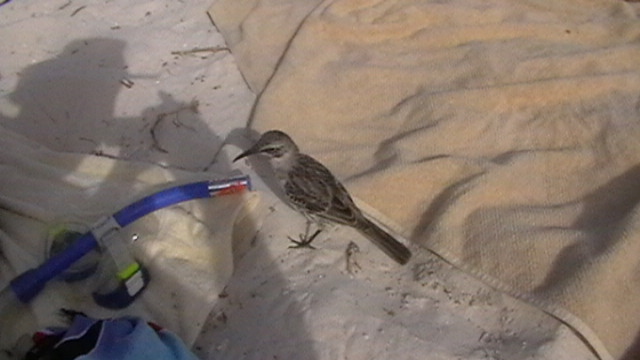
Galapagos Mockingbird about to take up snorkelling


Back on ship we relaxed on deck until dinnertime.  Following dinner most people went to bed fairly early to catch up with sleep, and to attempt to get to sleep before we started moving again.